
Congress Name: 10th World Archaeological Congress (WAC-10)
NT destination: Darwin, Northern Territory (NT), Australia
Congress venue: Charles Darwin University - Danala Education and Community Precinct, Darwin City
Delegates: 2000+ delegates from 80 countries
LINK TO WAC-10 CASE STUDY VIDEO
Studying the past to enhance the future
The World Archaeological Congress is a non-government, not-for-profit membership organisation which brings together archaeologists, heritage professionals, anthropologists, historians and Indigenous leaders from across the globe for a week of knowledge sharing, cultural exchange and global collaboration.
The Congress is quadrennial and this was the first time it had ever been held in Australia. It focuses on providing professional training and public education, including for disadvantaged nations, groups and communities. It also aims to empower and support Indigenous groups and First Nations Peoples, offering scope for discussion on archaeological research, policy, practice and politics.
The 2025 Congress was held in the Northern Territory’s capital, Darwin, and was hosted by Australia’s Flinders University in partnership with the Northern Institute of Charles Darwin University (CDU). Sessions were held at CDU’s city campus Danala located in the Darwin Central Business District.
Why Darwin and the NT?
A range of factors led to the NT’s selection as the host destination. These included Darwin’s strategic proximity to Asia, the NT’s capacity to provide a meaningful connection to the world’s oldest living culture, and an array of significant archaeological and cultural heritage sites that delivered the optimum experience for over 2000 Congress delegates from 80 countries.
The NT displays a demonstrable commitment to Indigenous-led research and storytelling with institutions such as CDU and Flinders University having strong partnerships with Traditional Owners and also being leaders in community-based archaeological research.
A diverse archaeology program
The WAC-10 academic program incorporated 175 sessions focussing on 26 different themes, with 20 sessions running concurrently. The program included plenary and general sessions, workshops, panel discussions, poster presentations and also a screening of acclaimed Aboriginal movie “Ten Canoes”.
A cultural festival ran parallel with the program and showcased Indigenous cultures from various nations, including Australian Aboriginal Elders, teachers and artists sharing their stories, artworks and ancient traditions.
Technical tours guided by scientists and the Traditional Custodians took delegates to places of archaeological and cultural significance in UNESCO World Heritage Listed Kakadu National Park. They were able to view ancient rock art and also meet and engage with the Traditional Owners of the land whose culture dates back 65,000 years.
Learning from the world’s oldest living culture
Delegates indicated that the destination’s cultural connections made a significant contribution to the success of the Congress. The cultural theme was highlighted at the Opening Night Reception staged at the NT’s premier cultural facility, the Museum and Art Gallery of the Northern Territory, where the Annual Telstra National Aboriginal and Torres Strait Islander Art Awards were also being exhibited.
The Gala Awards Dinner staged for over 1200 guests in extensive parkland on the Darwin Esplanade overlooking Darwin Harbour featured performances by the award-winning The Youth Mill Performing Arts Co. Another evening event staged at Mindil Beach Sunset Market enabled delegates to stroll amongst more than 200 speciality stalls featuring multicultural cuisine, art, crafts and entertainment.
Legacies and community engagement
As part of its training and education focus, WAC-10 developed a crowdfunding program to support attendance at the Congress for twenty early-career women from developing countries. The formation of a new group to be known as ‘Women In Archaeology’ was another Congress outcome.
The launch of the Barunga Aboriginal Knowledge Centre, which provides a platform for Aboriginal people in a remote NT region to earn income by teaching cultural protocols and undertaking Aboriginal society research, was also part of the official program.
In their words
“I don’t think Darwin can be beaten as an international congress city. With 50% of our delegates coming from overseas, Darwin was a great destination in terms of air access. The direct flights from Singapore took just over four hours, with connections from the UK, Middle East, Africa, America and beyond.”
“For Flinders University, the NT holds a special place in our archaeology teaching and research. For over 30 years our researchers have been helping to uncover the region’s deep and diverse stories – a commitment that continues to this day. I think the delegate takeaway from WAC-10 will be the vibrancy of the NT, the relaxed friendliness and the community. The Aboriginal culture is so accessible to people in the NT.”
Professor Claire Smith AO,
WAC-10 Academic Secretary & Professor of Archaeology, Flinders University
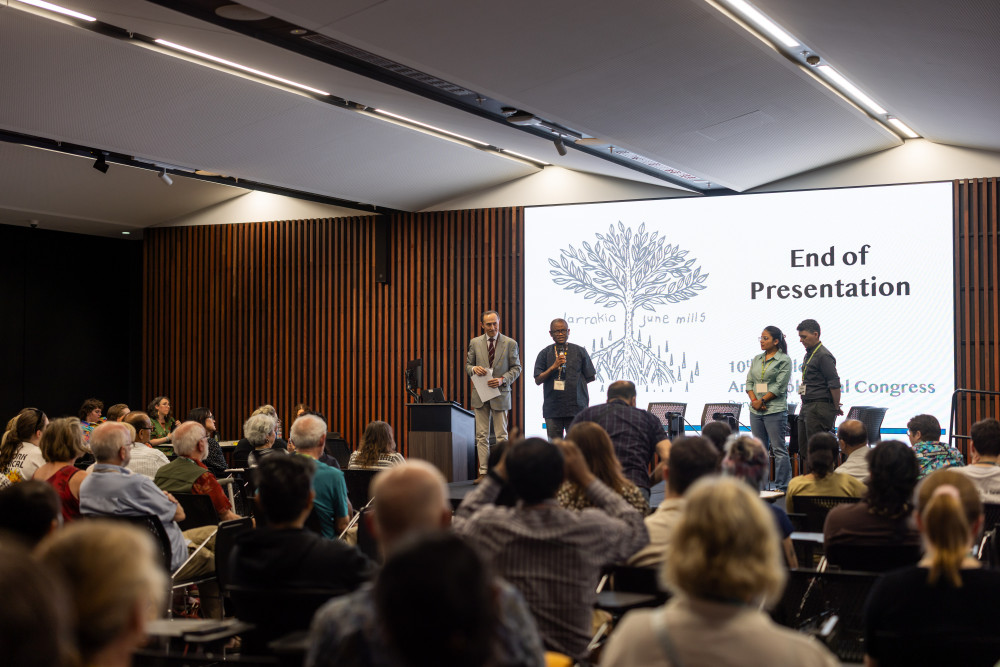
WAC-10 Endnote Address at the Charles Darwin University's Danala Campus